






Yvon Milliard
VanLife Campers Ambassador


Choosing the right batteries is a cornerstone of designing a reliable, safe, and durable electrical system for a camper van. At VanLife Campers, our mission is to build systems that align with our users' energy needs—whether for occasional getaways, long-term off-grid living, or year-round use, including in winter. It all comes down to one essential question: why invest in a recreational vehicle if its batteries prevent you from fully enjoying winter and the activities that come with it? Besides, who wants to use a generator these days, especially with battery prices constantly on the decline?
Making the wrong battery choice quickly leads to compromises: usage limitations, premature wear, unpredictable performance, or incompatibilities with the rest of the electrical system. This is why it’s crucial to understand the available technologies and their real-world implications. This is particularly true for AGM batteries: while they are functional, you should avoid discharging them beyond 50%, as doing so drastically reduces their lifespan. In practice, a 200 Ah AGM battery only safely provides about half of its rated capacity.


Batteries are the heart of the system. They store the energy required to power the fridge (often running continuously), ventilation, auxiliary heating, electric cooktops, water heaters (which are very energy-intensive), laptops, phones, cameras, Starlink, and more.
A well-designed battery bank must:
Operate reliably under the intended conditions of use;
Handle low temperatures and remain functional even in extreme cold;
Withstand deep discharges without compromising lifespan;
Support the discharge currents required by your appliances;
Be compatible with all charging equipment (alternator, solar, and shore power chargers);
AGM batteries were the standard for recreational vehicles for a long time. They work well, but with one major constraint: you must avoid discharging them beyond 50%, or you risk drastically shortening their lifespan. In practice, a 200 Ah AGM battery only safely provides about half of its rated capacity. Today, VanLife Campers no longer uses them in new conversions, and we generally advise against purchasing this type of battery.
Lithium Iron Phosphate (LiFePO₄) batteries are now the gold standard for modern systems. They allow you to use a large portion of their capacity without damage and charge much more efficiently. This is why more and more modern setups—if not all—are adopting Lithium batteries, especially since they can be self-heating, which is a massive advantage for our climate.
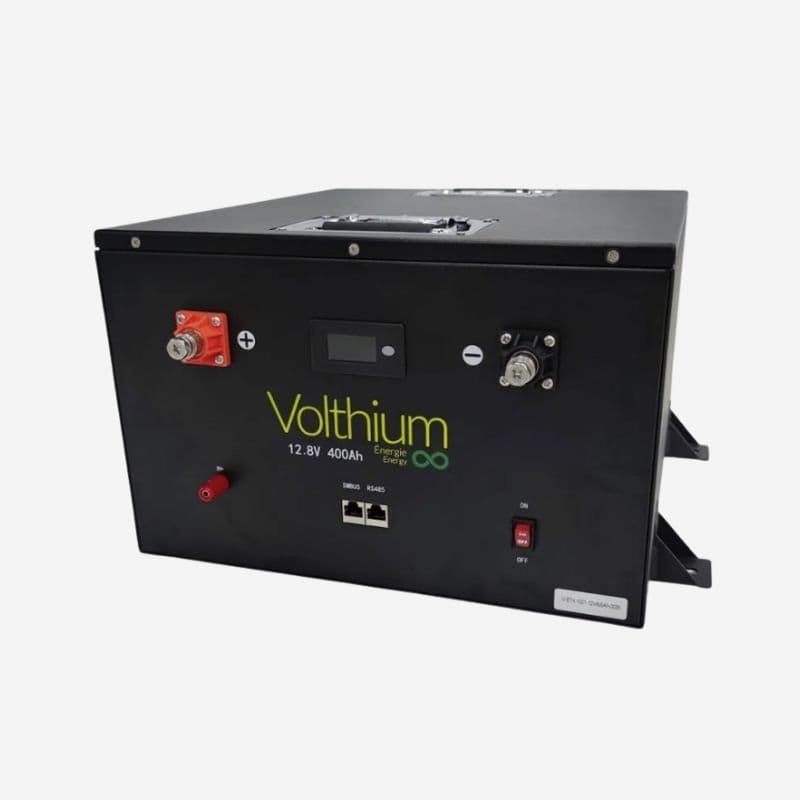
At VanLife Campers, we exclusively use Volthium self-heating lithium batteries. We primarily focus on 150 Ah and 400 Ah capacities, which cover the full range of typical needs.
Key Characteristics of Lithium Batteries:
The Role of the BMS
Modern batteries feature an integrated BMS (Battery Management System) that:
Protects against overcharging and excessive discharge;
Limits specific currents to prevent overcurrent issues;
Blocks all charging attempts if the cell temperature drops below 0°C (freezing point);
Balances the cells to ensure stable and uniform performance;
Monitors temperature, voltage, and current to optimize lifespan.
Discharging
Discharging: Lithium batteries can be discharged even in cold weather, typically down to −20°C for certain premium cells (such as Volthium Aventura).
Optimal Depth of Discharge (DoD): For daily use, a depth of discharge between 80% and 90% is ideal to maximize the total cycle count, though full discharges remain possible on an occasional basis.
BMS Protection: Thanks to the BMS, the battery can be used in extreme cold conditions—well below 0°C—without manual intervention and without any risk to the battery.
Recharging
Charging Below Freezing: A lithium battery must not be recharged below 0°C without an appropriate heating system, as this can cause permanent cell damage. In fact, the BMS will block any charging attempt—this is a critical feature to verify before purchasing your batteries.
Heating Logic: The BMS does not use the battery's own energy to heat itself during discharge. The heating element only activates when an external power source is present (such as solar panels, an alternator, or a shore power charger) and the temperature is low enough to require heating.
Self-Heating Models: Self-heating models, like the Volthium Aventura, use the incoming charging current to warm up the cells before allowing a full charge to proceed.
Safety Thresholds: The BMS blocks the charging process until the internal temperature reaches a safe level (typically between 5°C and 11°C to initiate the charge), eliminating any risk of damage.
Standard Lithium (Non-Heating): Most LiFePO₄ manufacturers recommend never charging below 0°C (32°F) because it can cause internal plating and irreversible damage.
Lithium Battery Lifespan
The longevity of a lithium battery isn't just a matter of discharge percentage. It primarily depends on:
Cell quality;
The BMS (Battery Management System) electronic management;
The charge and discharge currents applied;
The total number of cycles.

Volthium is one of the manufacturers we use and recommend. Other major and recognized players in the energy ecosystem include:
Volthium: (Self-heating LiFePO₄ batteries, high performance, and long lifespan);
Victron Energy: (The gold standard for management and charging equipment);
Bluetti or EcoFlow: (Integrated lithium solutions and portable power stations);
Battle Born: (High-quality LiFePO₄ batteries for RVs and mobile applications);
Relion: (Modular lithium batteries with advanced BMS);
Lion Energy: (Robust lithium solutions for mobile and residential use).
The brand isn't the only thing that matters; technical transparency, BMS quality, consistent specifications, and after-sales service are equally crucial.
Without diving into complex data tables, one of the most obvious advantages of lithium remains the capacity-to-weight ratio. As a point of reference, a 400 Ah lithium battery typically weighs between 40 kg and 47 kg, depending on the model and manufacturer. In contrast, a standard 100 Ah AGM battery (like the Renogy 100Ah or similar) generally weighs around 27 kg to 32 kg for that size.
This comparison illustrates that a single 400 Ah lithium battery—offering significantly higher capacity—weighs only about 1.4 to 1.7 times as much as a single 100 Ah AGM battery. To achieve a 400 Ah capacity using AGM batteries, you would be adding a massive amount of total weight. This further reinforces the lithium advantage in terms of energy density and weight savings for mobile applications.
Determining Your Power Needs
To properly size a battery system, you must first understand your actual energy requirements. The goal is to power your appliances and lifestyle without relying on a generator or propane, ideally by leveraging renewable energy sources like solar. Therefore, the system's size must be sufficient to ensure the necessary autonomy, even during extended periods without recharging.
Criteria for Choosing and Sizing Your Batteries
Maximum Load: Identify the highest continuous amperage your electrical system might draw. For example, a 3000W AC/DC inverter represents a maximum load of approximately 250A, which allows you to simultaneously run an 1800W induction cooktop and a 1000W toaster.
Location and Available Space: The physical size and total capacity of your batteries will be limited by the space available within your vehicle.
Desired Autonomy: Determine how long you want your batteries to power your equipment before needing a recharge. This involves factoring in the maximum depth of discharge (DoD) you plan to use.
Specific High-Drain Appliances: It is essential to consider high-consumption items such as:
Electric water heaters
Air conditioning (A/C)
CPAP machines
And more...
To maintain adequate energy performance even in winter—when you are off-grid for several days, parked, and our friend the sun gives way to the clouds—it is vital to equip yourself with high-capacity batteries.
Examples of Battery Setups Used by VanLife Campers
Here are some examples of the battery configurations we typically install at VanLife Campers:
2 x 100Ah Volthium Aventura Self-Heating Lithium Batteries
Total Capacity: 200Ah @ 12V (180Ah with recommended safety margin)
Best for: Weekend trips / Summer & Winter use
2 x 150Ah Volthium Aventura Self-Heating Lithium Batteries
Total Capacity: 300Ah @ 12V (240Ah with recommended safety margin)
Best for: Full-time living / Summer & Winter use / Electric water heater
1 x 400Ah Volthium Aventura Self-Heating Lithium Battery
Total Capacity: 400Ah @ 12V (320Ah with recommended safety margin)
Best for: Full-time living / Summer & Winter use / Sporadic A/C use / Electric water heater
2 x 400Ah Volthium Aventura Self-Heating Lithium Batteries
Total Capacity: 800Ah @ 12V (640Ah with recommended safety margin)
Best for: Full-time living / Summer & Winter use / Heavy A/C use / Electric water heater
Choosing the right batteries is central, but it cannot be separated from the ecosystem surrounding them. Without diving too deep into technical specs, it is important to understand that battery performance, safety, and longevity depend heavily on how they are charged and integrated into the electrical system. Battery selection and charger selection go hand in hand.
A high-performance, durable electrical system relies on total consistency between the batteries and all charging sources. Lithium batteries require chargers that are explicitly LiFePO₄ compatible, featuring charging profiles tailored to their specific chemistry. Using a charger designed for AGM or lead-acid batteries—if it is not configurable—will result in incomplete charging, a loss of autonomy, and, over time, a shorter lifespan for your lithium batteries. Conversely, an AGM-based system must also use chargers configured to its specific parameters.
When upgrading from an AGM system to Lithium, the question of chargers becomes paramount:
Some chargers can be reconfigured (via settings or firmware updates) to become lithium-compatible;
Others must be replaced, as they are incompatible with modern lithium charging profiles.
While the integrated BMS in lithium batteries provides cell protection, it never replaces a proper charger: the BMS acts as a safety net by blocking or limiting current during a problem, but it does not optimize the charging process.
A cohesive system relies on the alignment between:
The batteries;
The AC charger (120V shore power);
The alternator charging system (DC-to-DC);
The solar charge controller.
This alignment is what guarantees the performance, autonomy, and longevity of your entire system.
AGM batteries are now obsolete.
LiFePO₄ Lithium has become the standard for modern systems.
Self-heating batteries eliminate the constraints associated with cold-weather charging.
The BMS plays a central role in battery safety, protection, and longevity.
Charger selection and compatibility are just as important as the batteries themselves.
The use of generators is also obsolete.
Propane is phasing out: "No propane on board" is the new goal.
A properly sized installation can make alternative power sources redundant.
A high-performance electrical system relies on the consistency and harmonization of all its components. Understanding the interactions between autonomy, power, cold tolerance, and charging ensures optimal and safe operation in all circumstances.
Standard lithium batteries should never be charged below 0°C (32°F) as it can cause permanent internal damage. However, if you use self-heating batteries (like the Volthium Aventura), the system will automatically use incoming power to warm the cells to a safe temperature (between 5°C and 11°C) before allowing the charge to begin.
There is a massive difference. While you should only discharge an AGM battery to 50% to protect its lifespan, a high-quality LiFePO₄ battery can be used up to 100%. This means a single 100Ah Lithium battery provides the same usable energy as a 200Ah AGM bank, but at a fraction of the weight.
It depends on your current equipment. Lithium batteries require specific LiFePO₄ charging profiles to ensure safety and longevity. Some modern chargers can be reconfigured or updated via firmware, but older chargers designed strictly for Lead-Acid or AGM must be replaced to avoid incomplete charging and premature battery wear.